What are the most common mistakes companies make when backing up data?
Learn about the most common data backup mistakes and see how to avoid losses caused by ransomware, failures, and improper configurations in your company.

Many companies believe their backups are working correctly, but they have never performed a restore test. Without this process, there is no guarantee that the data can be recovered when an incident actually occurs.
However, strategic and technical failures continue to expose companies to losses resulting from ransomware attacks, human error, infrastructure failures, and incidents in cloud environments.
In this article, we clarify the main doubts related to backup, present the most common mistakes made by companies, and indicate ways to structure an effective data protection and recovery strategy.
What is data backup and why is it essential for your business?
Data backup is the process of creating secure copies of corporate information, allowing for its restoration in case of technical failures, cyberattacks, accidental deletions, or incidents that compromise systems and applications.
It is also a key component in disaster recovery strategies , ensuring that the company can restore data and resume operations after critical events such as ransomware attacks, infrastructure failures, or system unavailability.
Data recovery represents the final layer of protection against the permanent loss of critical information.
To better understand how these risks arise and what the main digital threats affecting companies today are, on our blog we explore how cybersecurity works and how to protect your company against digital attacks.
What are the main mistakes companies make when performing backups?
The most frequent mistakes do not stem from a lack of technology, but from the inappropriate way in which it is applied.
Among the most common errors are:
- Lack of periodic testing
Performing backups alone does not guarantee data recovery. Without regular restore tests, the company cannot be certain that files can be recovered in the event of a failure, ransomware attack, or accidental deletion.
- Backup storage
Maintaining backups in the same environment as the main operation increases the risk of simultaneous loss. In ransomware attacks or infrastructure failures, both the systems and the backups themselves can be compromised.
- Dependence on a single backup copy
Some companies maintain only one copy or do not diversify the types of backups, lacking a structured retention and multiple copy policy; recovery can become impossible after an incident.
- Lack of alignment with the LGPD (Brazilian General Data Protection Law)
Corporate data needs to be protected not only against loss, but also in accordance with legal requirements. The absence of retention policies, access control, and adequate protection can lead to regulatory risks and penalties.
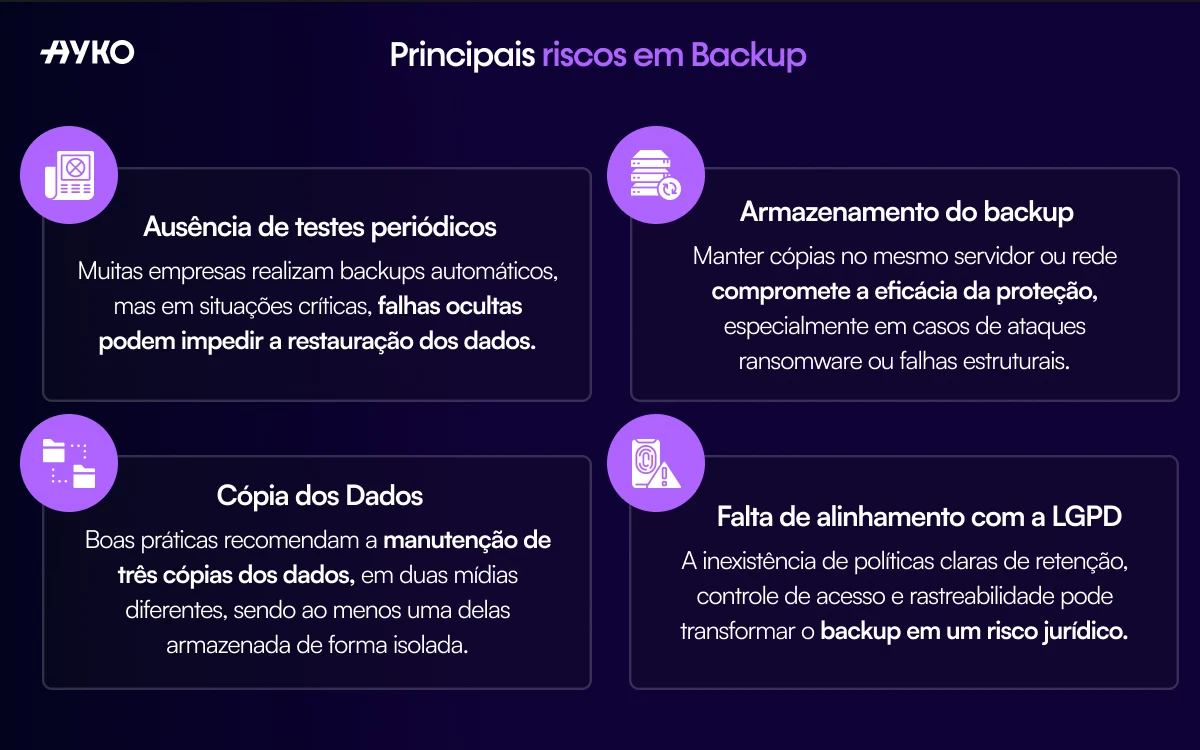
These errors are recurring, especially in companies that have expanded their infrastructure without reviewing their data protection policies.
Is the backup protected against insider threats and human error?
When discussing data loss , many companies associate the risk solely with external attacks. However, human error and internal failures are also among the most frequent causes of incidents, including accidental deletions, unauthorized changes, and incorrect configurations.
When backups lack access control, proper segregation, and continuous monitoring , they become vulnerable. In many cases, the failure is only noticed during restoration, when it's already too late.
Therefore, simply making periodic backups is not enough; it is essential to have a structured backup strategy to guarantee the integrity of information, even in the face of internal errors or unexpected incidents.
How to structure a backup strategy?
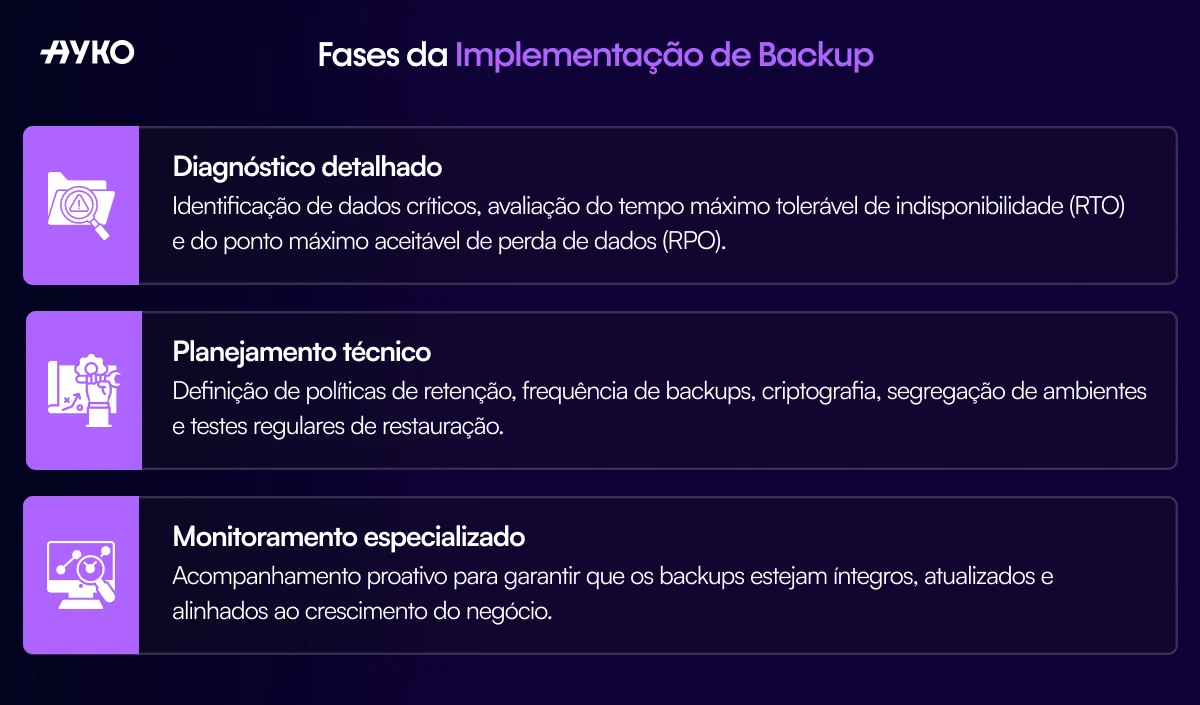
An effective data protection and recovery strategy must be based on three pillars. These are:
- Infrastructure diagnosis.
The first step is to understand the company's IT environment. This includes identifying which systems are critical, where the data is stored, what risks exist, and which processes depend on this information. Without this mapping, the backup strategy may not cover the most important assets.
- Definition of RPO and RTO.
These indicators determine the company's level of tolerance for incidents. The RPO (Recovery Point Objective) defines the maximum amount of data that can be lost, while the RTO (Recovery Time Objective) establishes the maximum time to restore systems after a failure.
- Continuous monitoring and management.
Backup is not a one-off activity; it requires monitoring execution routines, validating logs, testing restores, and periodically reviewing policies. Continuous management ensures that the process functions correctly and that data can be recovered when truly needed.
The continuity of operations also depends on complementary recovery strategies. In another article on our blog, we explain what disaster recovery is and how it protects your company's data after critical incidents.
Do you want to protect your company's data?
With over two decades of experience , Ayko operates in the implementation of complete backup, disaster recovery, and information security solutions, always focusing on operational resilience and regulatory compliance.
Many companies believe they are protected simply by having active backups, but only discover flaws in their strategies during recovery when the impact is already underway.
If your organization wants to assess whether its backup strategy truly ensures operational continuity and protection against ransomware, talk to the experts at Ayko.